Unsubscribe
View in your browser
Welcome
Welcome to the October 2026 Edition of the AABC Newsletter!
 

In this edition, our main focus is looking back on our recent Conference held at Maison Dieu, Dover. Remind you to participate in our 2026 Photography Competition, where we’re celebrating 'Detail and Decorating.'

Happy reading!

2026 Conference - Maison Dieu, Dover

Community and Civic Pride

Maison Dieu was a fitting setting for this year's AABC conference on 'Community and Civic Pride'. Its history, the restoration of William Burges's decorative scheme, the careful contemporary interventions and the project's engagement with Dover all speak to the question of how a historic civic building can remain part of community life.

One of our Directors Neal Charlton said

'The day had a particular resonance for me. I sat on the judging panels for both the 2026 AABC Conservation Award and the Civic Trust Awards, and it was a pleasure to share the building with AABC Register members alongside the architects, conservators and client who brought the project to life.'

The AABC conference at the Maison Dieu in Dover brought together two things that are often discussed separately: the care of a remarkable historic building and the people for whom it matters. The conference theme, “Community and Civic Pride”, was not simply a frame for the day. It was present in the building’s history, in the restoration decisions, in the programme of engagement and in the way the Maison Dieu is now being brought back into public life.

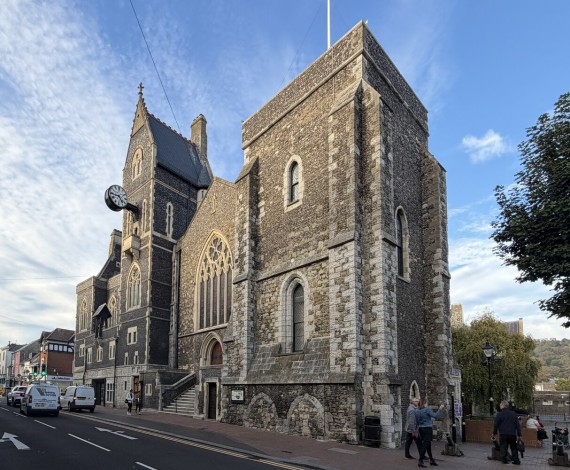
The Maison Dieu from the High Street, showing the relationship between its medieval fabric and later civic additions.

The Maison Dieu has occupied a central place in Dover for more than eight centuries. Founded by Hubert de Burgh around 1200 as a place of hospitality for pilgrims travelling to Canterbury, it later became a Royal Navy victualling yard before its conversion to civic use. Since the nineteenth century it has served as Dover’s town hall, courthouse and public gathering place. Its layered character is not an inconvenience to be resolved into a single architectural moment. It is the record of a building continually adapted to the needs of its community.

The building’s importance is also unusually concentrated. Its medieval remains, the Victorian work of Ambrose Poynter and William Burges, the later civic interiors and the collections held within it form a connected story. Burges’s contribution is of particular national significance. The Maison Dieu is his only civic commission and the only intact building in England to retain his decorative scheme, furniture and fittings. The task was therefore not simply to repair a town hall, but to understand how its different layers could be conserved and made meaningful again.

This was the context for the day’s talks. Roger Walton’s introduction traced the long commitment needed to bring the project to completion, from the early studies in 2014 through to the restoration and reopening. It was a useful reminder that complex conservation projects are built over time: through research, advocacy, funding, partnership and the steady work of keeping a shared purpose in view.

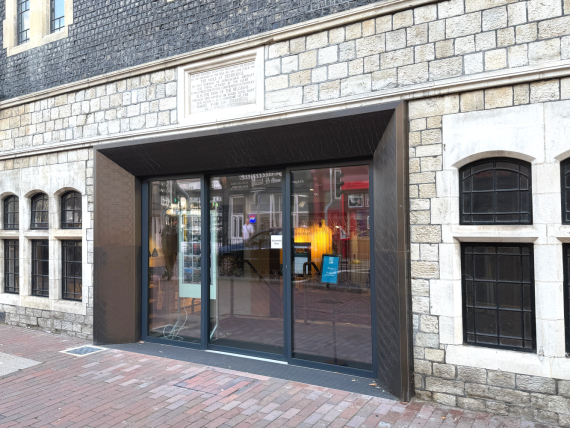
Tom Gibb’s talk on working with historic civic buildings spoke directly to the architectural challenge. The Maison Dieu needed substantial repair, improved access and a sustainable future, while retaining the qualities that make it distinctive. Tom’s influence on the scheme is clear. The new interventions are intelligent, beautifully detailed and unmistakably of their time. They do not imitate Burges or compete with the historic fabric. Instead, they make the building more welcoming and usable while allowing the older architecture to remain the principal voice.

The new accessible entrance on the High Street, a contemporary intervention set clearly within the historic elevation.

The project’s treatment of Burges’s decorative work provided one of the day’s most compelling examples of conservation informed by evidence. Tom Organ described the recovery of a decorative vision that had been obscured by later layers of paint. Small surviving areas helped reveal the original scheme, allowing the reinstatement of its pattern, colour and detail. The richness of the result is immediately apparent in the halls, where painted panels and ornamental motifs re-establish the relationship between structure and decoration.

A close view of the restored painted ceiling, showing the pattern, colour and precision of the decorative scheme

That achievement depends on the distinction between what survives and what has been reinstated. The original evidence has been conserved where it remains; new work draws on that evidence to recover the larger design. Rena Pitsilli-Graham’s contribution to the wider conservation of the building is exemplary. Her long involvement, from the research that helped secure the building’s Grade I listing to the development of its repair and reuse, reflects the depth of understanding needed to make decisions across a complex historic structure. Her talk on the technical challenges brought that work into focus: conservation is rarely a matter of one material or one intervention, but of understanding how the whole building behaves and how careful repair can support its continued use.

The talks on community engagement and fire safety widened the discussion beyond the physical fabric. Martin Crowther described the work of connecting people with the Maison Dieu through tours, school visits, community archaeology, workshops, events and opportunities to see conservation in action. This was not an engagement programme added at the end to explain a completed project. It formed part of how the building’s history was researched, shared and returned to the life of Dover. It also helped people see the skills and careers involved in caring for historic places.

The fire safety session from Steve Emery addressed another essential part of the same question: how do we keep a historic building safe while ensuring that it can continue to serve people? Fire safety, access and modern services can be difficult to accommodate in a complex historic building. They are also fundamental to its future. Conservation succeeds when such requirements are addressed as part of the architectural and operational thinking, rather than treated as problems to be hidden away.

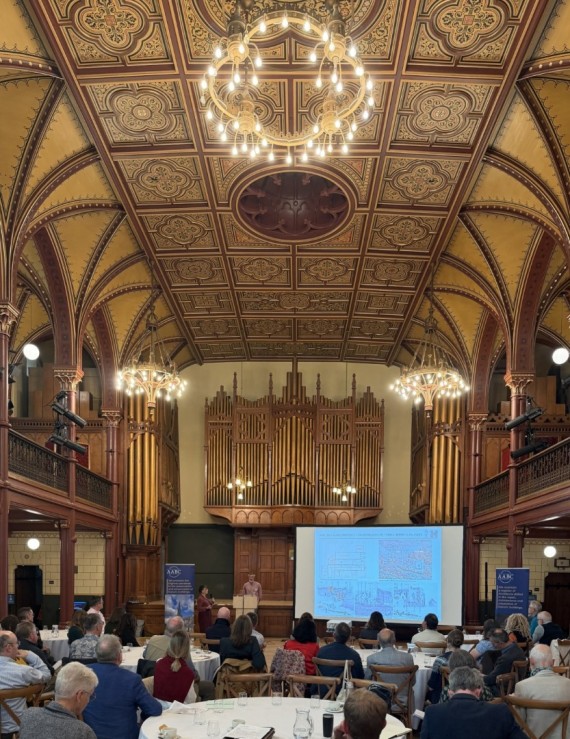
The AABC conference in the Connaught Hall, with the restored scheme forming the setting for discussion

The conference programme made the building itself part of the learning. Delegates could explore the Mayor’s Parlour and roof, see the historic interiors and external fabric, or take a guided walk through Dover. In each case, the building offered a way to connect architectural decisions with the town around it. The new accessible entrance, the repaired fabric, the conserved interiors and the renewed uses of previously underused spaces all contribute to the Maison Dieu’s return as a public place.

The choice of venue carried particular meaning for me. The project received the 2026 AABC Conservation Award, and the wider scheme also received a Civic Trust Award. I sat on the judging panels for both awards, so I had already considered the project through the discipline of assessment. The conference gave me the opportunity to share the building with members of the AABC Register alongside the architects, conservators and client whose collaboration made it possible. I also presented at the AABC AGM as a Board member, reflecting on the relationship between the AABC and the Civic Trust and the value of recognising conservation work. That combination of professional recognition and direct experience mattered. Awards can identify the quality of a project, but being in the building with the team who delivered it allows the reasons for that quality to be understood: the research, the judgment, the technical knowledge and the care taken to make new work sit well with old.

The Maison Dieu’s restoration shows that civic pride is not produced by architecture alone. It grows when a building is cared for, opened up and given a meaningful role in contemporary life. The conference asked how historic civic buildings can contribute to their communities. In Dover, the answer is visible in the building itself, but also in the people who now have the opportunity to enter it, learn from it and take part in its future.

2026 Photograph Competition

Don’t forget — entries are open for the AABC 2026 Photo Competition!
This year’s theme, Detail and Decoration. From intricate carvings and material textures to crafted finishes and ornamental features, we invite you to explore how attention to detail and decoration contribute to the character and identity of historic buildings. 


How to Enter
Deadline: 31 December 2026

Submit by email:
administrator@aabc-register.co.uk
Subject: AABC Photo Competition 2026 Entry

Please include:

  • Your name

  • Building name and location

  • Instagram username (optional)

Maximum of 3 entries per person
Open to both AABC members and non-members


Prizes and Recognition

The winning photograph will be featured on the AABC website and celebrated in the Spring 2027 AABC Newsletter. The winner will also receive a cash prize of £200.

Selected photographs will also be:

  • Showcased at the 2027 AABC Conference

  • Featured on the AABC website and newsletter

  • Eligible for special commendation by the AABC judging panel

Let your images reveal the richness of detail and decoration in conservation architecture.

By submitting, you grant AABC permission to use your photographs for promotional purposes, including social media. If your photographs include people on site, appropriate PPE must be worn where required.

We can't wait to see how you interpret this year's theme. 

We welcome entries from professionals, students, and enthusiasts alike — up to three photos per person.

New Member Profile

An insight into the process of applying, the Mentee scheme and the benefits of joining the AABC.

This month we are delighted to share thoughts from Sinead Scullion a former mentee who is now accredited. She shares with us how she found working through the scheme and what she hopes to achieve in the future.

Name: Sinead Scullion

Company: The National Trust for Scotland

Location: Edinburgh

Accreditation Category: Architect

What inspired you to pursue accreditation in building conservation and the AABC mentee scheme?

I have been excited to apply for AABC accreditation for sometime as it is a highly regarded scheme that will help me to continue professional and personal development in the realm of built heritage conservation.

Although there are useful resources available, such as Guidance Notes and Q&A sessions, I applied to the AABC Mentee Scheme for advice on how to directly interpret the requirements into my application. Given that the application took a lot of work, it was great to have this support in focusing my submission and filtering relevant experience into the strict formatting.

How do you think your accreditation will impact your work in building conservation?

I am very fortunate to have worked on some fantastic projects to-date, and securing this accreditation will allow me to pursue further interesting and exciting work. I strive to have a positive impact on my projects and I am very careful in my work, so I appreciate that holding AABC will support my position in delivering same. 
 
What advice would you give to others considering accreditation and conservation work?
 
It took quite some time to compile the application so I would recommend keeping ongoing records of projects and CPD. 
 
In your opinion, what is the most pressing issue facing building conservation today?
 
Although we are lucky to work in a close and supportive network of conservation colleagues from many disciplines, there are still multiple issues that spring to mind. 
 
For example, in my daily work we are noticing the effects of climate change, particularly in terms of frequency and severity of storm events. These escalate the need for constant maintenance and regular repair projects to address items such as; active vegetation growth, leaks through damaged external envelopes, rainwater goods capacity, and the like. 
 
I also think that a small supply of traditional building materials is a pressing issue, particularly when working on vernacular projects such as thatched or natural stone roofs. This is particularly difficult when trying to address a range of repairs, from small patches, to larger interventions.  
 
What are you looking forward to in your career? Any dream projects? Skills you’d like to develop?
 
I really love my current job, so I'm excited to continue working on a range of projects across my region at the NTS. In my role I have the opportunity to engage with many different professionals, from stone conservators to rot hounds, and holding this accreditation will help me develop relationships with them onsite. Given that all projects are different, I've found that our various colleagues are similarly passionate in working with built heritage and they are happy to collaborate in figuring out how to protect our shared built heritage. Although I now hold this accreditation, I still have much to learn and I can't wait to further explore this field. 
 
How did your mentor help you on your journey to accreditation?
 
On preparing the application, my Mentor was really helpful in advising which projects I should consider for the case studies to demonstrate a breadth of experience. In addition to having a few meetings to discuss approach, they were also available by email and provided prompt and valuable response to queries that came to light. The application takes a lot of work so I greatly appreciated steers from my Mentor to focus output, especially during earlier stages in the process.  
 
If you are thinking of applying to become a mentee, the scheme is open to anyone who has completed their Part II in architecture. Whether you're new to the field or have years in practice, this program provides tailored guidance to help you achieve AABC accreditation. 
 
If you have any questions, please contact us at administrator@aabc-register.co.uk.
 
Read our Guidance Notes on how to apply below.
AABC Mentee Guidance Notes
CPD Opportunities

Connecting knowledge, technology and conservation: Building competence for the future of built heritage

A digital learning framework for informed decision-making.

The conservation of historic buildings and places is increasingly recognised as a complex, interconnected challenge. Protecting built heritage requires more than technical expertise in individual disciplines; it depends on collaboration between owners, policymakers, administrators, architectural technologists, architects, engineers, specialists, researchers and other building/technology professionals.

Historic assets are affected by physical change, environmental pressures, evolving materials, social expectations and new digital approaches to understanding and managing information. Addressing these challenges requires people from different backgrounds to share a common understanding of conservation principles and develop an ability to make informed decisions.

This means recognising structural change, diagnosing deterioration, understanding context and applying international guidance, legislation and ethical standards. It also requires individuals to understand the limits of their own expertise, identify when specialist knowledge is needed and communicate effectively across other disciplines.

For the digital technology sector, this shared understanding is increasingly important. Digital tools, data capture, modelling, monitoring systems and emerging technologies can only support conservation effectively when they are applied within a clear understanding of heritage values and decision-making processes.

This article seeks to make you aware of the range of COTAC material that is freely available to download from www.cotac.global

COTAC's digital learning approach

COTAC’s online learning framework has been developed to support this wider understanding through accessible, structured self-learning resources available through the Learning Menu.

The programme is structured and based on the International Council on Monuments and Sites 14-point Education and Training Guidelines, providing an internationally recognised foundation for understanding the skills and responsibilities involved in caring for built heritage.

The learning approach is designed around progressive development as follows:

Appreciating (green box) - Being Aware of (orange box) - Becoming Skilled in (blue box)

It allows learners to begin with an understanding of why heritage matters, develop awareness of conservation challenges and progress toward more informed professional engagement.

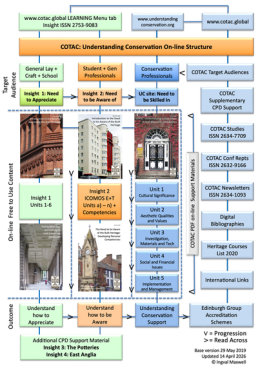
COTAC Understanding conservation online structure

The diagram below illustrates how the COTAC learning ecosystem connects different audiences, resources and outcomes. The green, orange and blue boxes equate to “lay learning”:

  • green box (general lay + craft + school), slightly more advanced “awareness”
  • orange box (student + general professional), then covering those who are “skilled in”
  • blue box (conservation professionals).

The diagram then identifies which of COTAC learning documents directly apply to the three identified learning cohorts – this is defined by the containing broken blue line boxing

The structure demonstrates how different learning pathways support different levels of engagement:

Insight 1: The Need to Appreciate the Built Heritage

Designed for a broad audience including general learners, craft professionals and those beginning their conservation journey.

This stage introduces the fundamentals of conservation through six learning units covering:

  • Understanding heritage significance
  • Observing and interpreting historic places
  • Appearance and character
  • Building performance
  • Conservation challenges
  • The consequences of intervention

The aim is to develop an informed appreciation of the built environment and the reasons why it requires careful consideration. 

Insight 2: The Need to be Aware of the Built Heritage

Building upon this foundation, Insight 2 develops a deeper awareness of conservation principles and introduces the ICOMOS Education and Training Guidelines.

It includes:

  • Exploration of the fourteen ICOMOS guideline areas
  • Annotated image-based learning resources
  • Supporting digital bibliography and references
  • Development of personal competencies

This stage encourages learners to consider how conservation decisions are made and how different forms of knowledge contribute to successful outcomes. 

Developing Personal Competencies

A key part of Insight 2 is the additional volume:

This resource focuses on differing but developing ability individual roles within the wider conservation process.

Rather than concentrating only on technical knowledge, it encourages reflection on:

  • How decisions are formed
  • How evidence is interpreted
  • How different specialists collaborate
  • How responsibilities are shared
  • How professional judgement develops

The material explores fourteen personal competencies aligned with the ICOMOS guidelines and presents them through five structured parts.

These competencies are particularly relevant in a technology driven environment where successful conservation depends on collaboration between heritage specialists and digital innovators.

Becoming Skilled in Conservation Support

The next stage of the learning pathway supports those seeking a more advanced understanding of conservation practice.

The “Understanding Conservation” programme consists of five units:

  1. Cultural Significance
  2. Aesthetic Qualities and Values
  3. Investigation, Materials and Technology
  4. Social and Financial Issues
  5. Implementation and Management

This stage links conservation philosophy with practical application, supporting professionals involved in managing, researching and delivering conservation activities.

Creating a shared language between heritage and technology

The future of built heritage depends on stronger connections between various but contributing disciplines.

Digital Technology can transform how historic places are recorded, analysed, monitored and managed. However, successful innovation requires an understanding of the values, responsibilities and decision-making processes that define conservation practice.

COTAC’s learning framework provides a bridge between these technical/professional worlds by creating a shared foundation of knowledge.

Through structured online learning, downloadable resources and internationally aligned guidance, the programme supports a growing community of informed contributors — from heritage professionals to digital technology specialists — working together to protect the built environment for future generations; in addition: it accommodates those at a lay and learning level in order to gain a basic but ‘appreciative’ understanding of conservation.

AUTHOR: Barry Bridgwood MCIAT

Explore the full learning structure
Newly Accredited Architects

Welcome to the following new members who have recently gained AABC Conservation Accreditation status.

Andrew Hedger

Chloe Sheward

Giles Pritchard

Sarah Harrison

Sinead Scullion

Neil King

41 Bengal St Manchester M4 6AF

administrator@aabc-register.co.uk

0161 832 0666

 Web  Linkedin  Instagram